
The wide link
Cellular backhaul, including GSM, where the network reaches the bench or the surface.
You know what you bought. You do not know what each machine burned. A rigid probe, custom-cut and calibrated, reads the liquid. Engine hours are not a substitute.
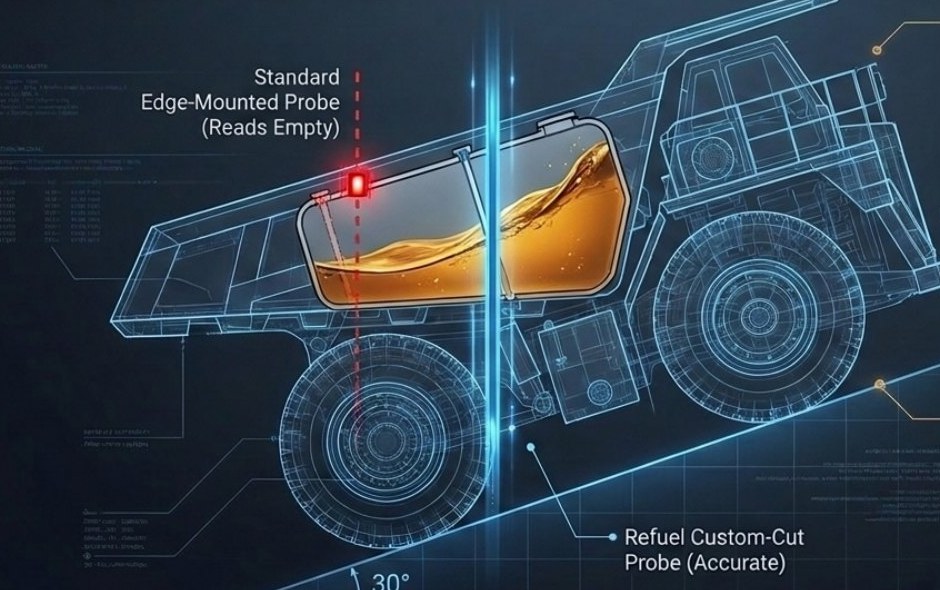
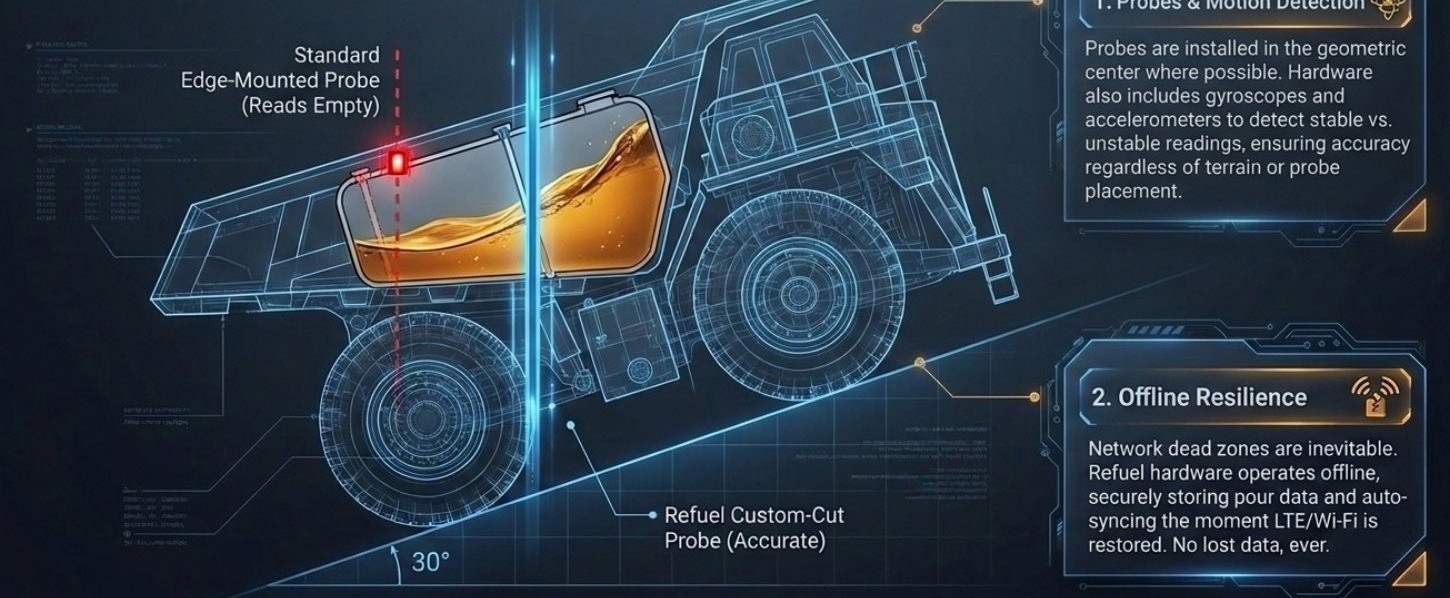
Probes are installed in the geometric centre where possible, so slosh on an incline does not throw a false drain alert. An edge-mounted probe on the same slope can read empty.
Hardware includes gyroscopes and accelerometers, so the system can tell a stable reading from an unstable one, whatever the terrain or the probe placement.
A rugged gateway filters noisy raw data on the machine. Only the cleaned intelligence is sent up. GPS puts movement, idling and fuel events on the same map.
Dead zones are expected. The hardware stores the pour offline and syncs when LTE or Wi-Fi returns.
NFC authentication and solenoid control on the dispense. Four beats from the approach to the sync.
The operator comes to the bowser or the point of dispense.
The NFC app confirms who is allowed to pour.
Fuel moves only after that authorisation. The solenoid stays in the loop.
The pour is captured offline and syncs when the link is back.
Every litre is tied to a user, a vehicle and a location.
Tri-layer connectivity for deep-mine zones: LTE, Bluetooth beacons and built-in Wi-Fi, with GSM where that is the cellular path. Most monitoring stops short of Wi-Fi. Where the Mine Health and Safety Act requires it, intrinsically safe options are part of the offer.
Cellular backhaul, including GSM, where the network reaches the bench or the surface.
A local path when the machine is underground or out of cellular range.
The third path, so the record does not depend on one radio.
Real-time burn rates, accurate run hours and idle times. Harsh driving and geofenced zones sit on the same asset.
Automated alerts for overdue services, unauthorised idling and harsh driving. Theft and unauthorised draining are flagged as they happen, not at month-end.
Asset health from engine-hour telemetry, so maintenance is preventative. And a flag when fuel is burning and the machine is not moving dirt.
Audit-ready logs, not a reconstructed logbook. Qualification often reaches 72–80%.
Heavy industry loses an estimated 5% of fuel to shrinkage and inefficiency. Correlating pour and receive is how that capital comes back.
Assets are accounted for. Manual reconciliation ends. The same pattern scales, and the outcome is net cash positive from year 1.
Is your fuel data truly data you can trust?